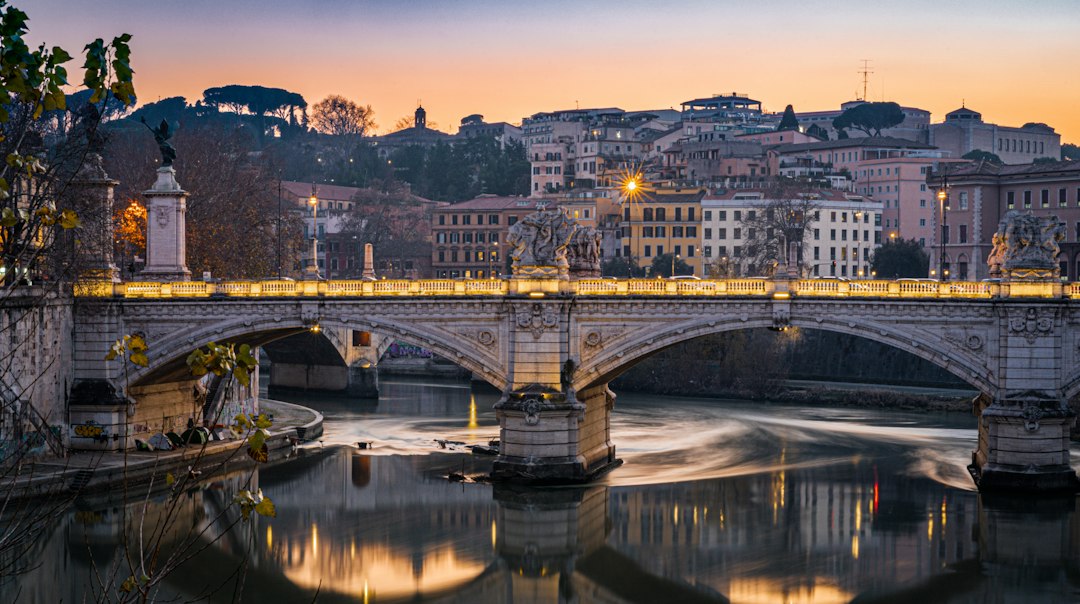
Un racconto filosofico originale di Giuseppe Tocchetti — In una Roma fuori dal tempo, Paolo di Tarso, Leone XIV, Søren Kierkegaard e Friedrich Nietzsche si incontrano sulle rive del Tevere. Un dialogo immaginario fra fede, dubbio, autorità e libertà di porre domande.
Nota editoriale: opera narrativa di fantasia. I dialoghi sono inventati e non rappresentano dichiarazioni autentiche delle persone citate.
ROME.
It’s hard to tell what century this evening belongs to. Then again, Rome has always been pretty good at mixing up the centuries.
Along the Tiber, near Testaccio, a man dressed in white is walking alone. It’s Leo XIV.
He’s not walking like a man on official business. There are no barriers, no greetings, no photographers. He walks slowly, like someone who has set down the public weight of his role for a few minutes to deal with something that nobody else can deal with for him.
A question.
Maybe the oldest question of all.
What happens when a man is given the responsibility of providing answers for other people?
The river flows beside him without saying a word. A cool breeze moved across the river.
Somewhere beyond the embankment, dishes rattled on the terraces of Testaccio. Rome carried on with its evening, unaware that two thousand years had just folded in on themselves .
Then someone shouts behind him.
"Wait!"
The Pope turns around.
A man is running toward him. He’s out of breath, his robe is dusty, and he looks like someone who isn’t quite sure whether he’s chasing another man or one of his own questions.
When he finally catches up, he bends slightly, trying to catch his breath.
"I’ve been looking for you."
Leo XIV studies him.
"And who are you?"
The man raises his head.
"Paul. Of Tarsus."
The scene alone would be enough to confuse any journalist.
Paul of Tarsus, one of the central figures of early Christianity, is standing face to face with the 267th Pope of the Catholic Church.
Almost two thousand years separate the two men.
And yet, for reasons this story cannot explain, time itself seems to have stopped behaving normally that evening by the Tiber.
Leo XIV looks at him with surprise.
"You should be the one I’m looking for."
Paul is still breathing heavily.
"That’s exactly the problem."
"What problem?"
"That after all this time, you’re still looking for me."
They begin walking together.
For several moments neither of them says anything.
Then Paul breaks the silence.
"Tell me something. Do you people still have questions?"
The Pope smiles slightly.
"Of course."
"Then why have you built so many answers?"
There is no hostility in the question.
It sounds more like the doubt of a man who has returned after twenty centuries and found something much larger than what he remembers leaving behind.
Paul belongs to the earliest phase of Christianity’s expansion. His life was filled with preaching, journeys, the creation of communities, and an existence completely reshaped by faith.
Here lies the first paradox of the evening.
The man of the mission meets the man of the institution.
"Answers," the Pope finally says, "also exist so people don’t have to start over from the beginning every single time."
Paul nods.
Then he asks:
"And what if they should?"
The Pope stops.
"Start over?"
"At least once in their lives."
A little farther down the river, two voices can be heard. The smell of damp stone rose from the riverbanks. Streetlights were beginning to shimmer on the dark surface of the water .It’s not a calm conversation.
A tall man with a mustache gestures angrily. In front of him, another man, quieter and more reserved, responds with such stubborn calm that it only makes the first man even more irritated.
Friedrich Nietzsche and Søren Kierkegaard are arguing.
A meeting that could never happen historically, yet feels completely inevitable philosophically.
"You can’t take risk away from human life!" Kierkegaard exclaims.
Nietzsche shakes his head.
"You only want to replace ordinary comfort with religious risk."
"No. I want to return the individual to choice."
"And I want to know why anyone should choose your answer."
Paul looks at Leo.
Leo looks at Paul.
They immediately recognize the problem.
Before long, the four men find themselves walking along the same stretch of the river.
None of them seems especially pleased about the coincidence.
Nietzsche is the first to address Paul.
"So you’re the apostle."
It isn’t a question.
"That’s what they call me."
"No. That’s what you became. I want to know who you were one moment before that."
Paul stays silent.
The Pope watches Nietzsche carefully.
The question has something deeply genealogical about it.
It isn’t asking what a person believes.
It’s asking what created the need for that belief.
"So," Paul says, "you want to know whether I discovered a truth or whether I needed to discover one."
For the first time, Nietzsche smiles.
"Now we can have a conversation."
Kierkegaard steps in.
"But those two things don’t necessarily exclude each other."
Nietzsche turns sharply.
"There he is. The defender of the leap."
"I’m not defending a doctrine. I’m defending the individual’s right to commit himself to a choice."
Paul listens.
Then he says something that surprises everyone.
"Maybe that’s what I was afraid of while I was running."
"Afraid of what?" asks Leo.
Paul points toward the Pope.
"You."
Leo XIV doesn’t react immediately.
"Explain."
"I spent my life carrying a conviction. You spend yours carrying an institution."
The Pope keeps looking at him.
"Those aren’t the same thing."
"No."
Paul walks over to the river wall.
"I could be wrong by myself."
Leo immediately understands.
"And you think I can be wrong for millions."
"I think anyone who guards an answer for millions of people should ask himself that question."
This is not a personal accusation.
It’s the problem of authority itself.
The Pope rests his hands on the railing. A tour boat slid beneath the bridge. Its lights rippled across the water and briefly illuminated the four faces before disappearing .
"But if every generation destroyed what it inherited and started searching again from scratch, what would remain of memory?"
Paul doesn’t answer.
Kierkegaard does.
"Nobody has to destroy the answer."
He steps forward.
"They only have to stop it from becoming too easy."
The discussion begins to change.
It is no longer just about Christianity.
It is about inheritance.
Every human being is born into a world already filled with meaning.
We inherit a language we didn’t invent, values we didn’t create, institutions that existed before we were born.
Religion simply makes this especially obvious.
Leo XIV represents a tradition.
Paul represents the moment when that tradition was still a living transformation and a personal testimony.
Two movements emerge.
From Paul to the community: from experience to shared meaning.
From the institution to the believer: from shared meaning back to personal experience.
"Your problem," Kierkegaard says to the Pope, "isn’t that you have an answer."
Leo looks at him.
"Then what is it?"
"Making sure a person doesn’t stop becoming an individual simply because the answer has been handed to him."
Nietzsche laughs.
"Always too generous."
"And you’re always too confident in doubt," Kierkegaard replies.
Nietzsche starts walking again.
The others follow.
"You all keep talking as if the issue is making the answer authentic."
He points to Paul and then to Leo.
"I want to question the need that comes before the answer."
"What need?" the Pope asks.
Nietzsche turns around.
"The need for the world to have a reason at all."
The sentence hangs in the air.
Perhaps this is where the distance between Nietzsche and the other three becomes most obvious.
For Paul, meaning has been discovered.
For Leo, meaning has been received, preserved, and passed on.
For Kierkegaard, meaning must be personally embraced through a choice that no group can make for an individual.
Nietzsche places doubt even before the answer:
Why do we assume existence owes us an explanation?
By now evening has fully arrived.
Leo XIV returns to the original question.
"Let’s suppose a child receives an answer before he even has the words to ask the question. What should we do? Stay silent?"
"No," says Kierkegaard.
"Then teach him?"
"Not only that."
"Then what?"
"Give him enough freedom that one day he can question what we’ve taught him."
For the first time, Nietzsche looks at the Dane without irony.
He may not agree with the religious conclusion, but he recognizes the problem.
The real choice is not between authority and the absence of authority.
It is between an authority that allows questions to survive and one that considers them dangerous.
Paul listens and slowly begins to understand why he ran so hard to catch up with the Pope.
He didn’t want to know whether Christianity had survived.
He wanted to know what had become of the question that gave birth to it.
The four men continue walking.
At this point, perhaps the journalist should simply observe.
None of them seems to have won.
Nietzsche has not eliminated humanity’s religious need.
Kierkegaard has not proven that faith is necessarily the destination of every search.
Paul cannot know what a conviction becomes after two thousand years.
Leo XIV cannot return an institution to the moment of its birth.
And yet something has changed.
They have separated four things that are too often confused:
searching for an answer, finding it, passing it on, receiving it.
They are not the same act.
Millennia can pass between the first and the last.
Eventually it is time to part ways.
Paul turns to Leo.
"Now I know why I was running."
"To reach me?"
"No."
He smiles.
"To reach what my answer had become."
The Pope lowers his eyes.
"And what did you find?"
Paul first looks at Kierkegaard, then at Nietzsche.
Finally he looks at the river.
"An answer much bigger than my question."
Nietzsche immediately jumps in.
"And that is supposed to comfort you?"
Paul slowly shakes his head.
"No. That’s exactly what worries me."
Kierkegaard smiles.
Leo remains thoughtful.
Then he asks:
"What should someone do who is responsible for protecting that answer?"
For once, Nietzsche says nothing.
Neither does Kierkegaard.
Paul looks at his distant successor in the history of Christianity and says:
"Maybe remember that before the answer there was a person."
"And before the person?" asks Nietzsche.
Paul looks at him.This time he smiles. A gust of wind crossed the river. Somewhere a church bell rang the hour.
"The question."
If, the next morning, a journalist had gone looking for proof of the meeting, he would have found nothing.
No statement.
No photographs.
No documents.
Only the Tiber continuing to flow beside Testaccio.
But the strangest part of the encounter would not be the impossible sight of Paul of Tarsus, Leo XIV, Søren Kierkegaard, and Friedrich Nietzsche together.
It would be the question they left behind.
Religion can preserve an answer through the centuries.
Philosophy can challenge it with doubt.
An institution can protect it and pass it on.
An individual can accept it or reject it.
But none of these actions is exactly the same as the original act of searching.
Perhaps that is the symbolic tension between Paul and the modern Pope.
One can be seen as the man who brought a life-changing answer to a community.
The other as the man called to bring back to the individual an answer that the community has preserved for centuries.
Between them stand Kierkegaard and Nietzsche.
One asks the answer:
"Has it truly become mine?"
The other asks the need itself:
"Why do you desire an answer so deeply?"
And that may be why, in this impossible story, none of the four could bring the discussion to an end.
Because a genuinely philosophical question does not always ask to be closed.
Sometimes it simply asks to be returned to a person before someone else answers it for them.
Testo originale in lingua inglese di Giuseppe Tocchetti. Foto di copertina: Alberico Bartoccini / Unsplash (veduta del Tevere a Roma; immagine illustrativa, non del luogo esatto della scena).
Follow us on Tweet.app — IT: condividi con noi quale domanda vorresti fare a questi quattro protagonisti. EN: Which question would you ask them?
Le storie belle si condividono.
Scegli dove portare questo articolo. I social si aprono solo quando li selezioni.
Vuoi leggerlo sul Kindle? Usa Stampa / PDF per salvare il testo, poi Send to Kindle (Amazon). L'invio non avviene automaticamente.
Commenti e riflessioni
Partecipa alla conversazione con rispetto. I commenti saranno visibili dopo la moderazione redazionale.
Lascia il tuo commento